- By: SEO SEO
- Category: Uncategorized
- 0 comment
When speaking of marble stone in construction, the image that instantly floats before one’s mind’s eye is that of the Taj Mahal – ethereal, luminous, and ever-beautiful. However the use of marble in construction goes back much further in time, with evidence of its use in ancient Egypt and Mesopotamia. With its enduring popularity, marble continues to be widely used in the building & construction industry in the 21st century. However, not all marble used in construction is the same. Finding the right marble involves knowing the different types of marbles and how they are used.
Generally speaking, a marble stone manufacturer makes and processes the stone, and a marble stone supplier sources and delivers it. Both matter for quality and timelines. Read on to know more about how to find the right marble stone for construction.
Marble Stone Types and Their Uses
The table below shows some of the common marble stone types and how they are used in construction.
| Marble Stone Type | Characteristics | Uses |
| Makrana White | Pure white tone, highly durable, minimal veining | Flooring, temples, monuments, wall cladding |
| Calacatta Marble | Bright white base with bold, dramatic veining, premium look | Feature walls, luxury interiors, statement flooring |
| Rainforest Green | Deep green base with brown and gold tree-like veining, bold organic patterns | Flooring, large wall surfaces, feature walls, statement interiors |
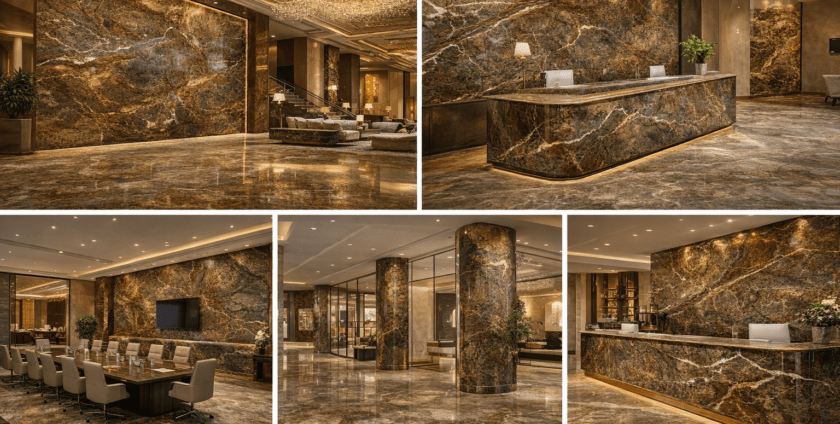
| Rainforest Brown | Earthy brown tones with tree-like organic veining | Flooring, large wall surfaces, feature areas |
| Emperador Brown | Deep brown colour with lighter veining, rich and warm look | Flooring, wall cladding, commercial and residential interiors |
| Carrara Marble | Soft white to light grey background, subtle linear veining | Flooring, bathrooms, countertops, wall applications |
| Onyx Marble | Translucent stone with layered bands, rich colours, dramatic patterns, allowing light transmission | Fireplace surrounds, bar tops, small islands, backlit panels, decorative wall cladding, luxury interiors, accent elements |
| Banswara Purple | White base with purple and grey veining, distinctive contrast | Flooring, wall panels, decorative interior elements |
Key Marble Stone Uses
Some of the common uses of marble stone in construction are as follows:
- Flooring: Offers a clean, elegant surface.
- Wall Cladding: Adds texture and depth on walls.
- Countertops: Strong surface when sealed.
- Architectural accents: Columns or trims for design impact.
How to Choose Marble Stone Manufacturers and Suppliers
The right partner makes a difference. Here’s what to look for:
- Quality: The stone should be consistent in color and finish.
- Experience: Experienced manufacturers and direct suppliers like Arvicon would be familiar with the different marble stone types.
- Availability: Stone must be in stock or ready to source quickly.
- Support: You should get clear guidance on handling and application.
A marble stone manufacturer controls the stone from quarry to finish. They can offer better quality control. Always check reviews and past projects before you choose.
What Affects Marble Stone Price
The marble stone price is determined by the following factors:
- Stone type: Rare or imported marble costs more.
- Finish: Polished, honed, or brushed surfaces differ in cost.
- Size and thickness: Larger and thicker slabs cost more
- Fabrication: Custom cuts increase price.
Why Arvicon is the Best Option
Arvicon is a reputed marble stone manufacturer offering a focused range of natural marble stones available in a variety of sizes, forms, and finishes for construction purposes. Our marble is cut to meet project-specific size requirements, helping architects and builders maintain consistency across flooring, wall cladding, and other applications.
Our marble portfolio includes Natural Marble Stone and Indian Marble Stone, along with distinct varieties such as Emerald Green, N H Green, Forest Green, Onyx Pink, Rainforest Green, and Rainforest Brown. These stones are selected for their durability, colour depth, and suitability for interior and exterior use.
Standard Marble Tile Sizes Available
| Tile Size | Use |
| 6″ × 6″ | Accent areas, small spaces |
| 12″ × 12″ | Flooring, wall cladding |
| 16″ × 16″ | Medium to large floor areas |
| 12″ × 24″ | Modern flooring, wall panels |
| 24″ × 24″ | Large-format floors, open spaces |
Set apart by superior physical properties, our marble products are designed to enhance the beauty of both indoor and outdoor environments.
FAQs
1. How do I choose marble for construction?
Match the stone type to the space usage. Consider traffic, maintenance, and finish needs.
2. What is the difference between a manufacturer and a supplier?
A marble stone manufacturer produces and finishes the stone. A marble stone supplier sources and delivers it. Well-known marble stone manufacturers like Arvicon are also involved in directly supplying to their clients.
3. Can marble be used outdoors?
Yes. Choose dense stones and proper finishes. Regular sealing helps protect the stone.
4. Does finish type change marble performance?
Yes. For instance, polished finishes look smooth but can be slippery. Honed finishes are better for floors.