- By: SEO SEO
- Category: Uncategorized
- 0 comment
Modern commercial architecture is shaped by pressure. Surfaces must perform consistently across large spans, withstand heavy daily use, and remain visually stable long after handover. In this context, material selection is less about appearance alone and more about predictability. That shift explains why sintered stone in architecture is increasingly evaluated for commercial environments where durability, maintenance, and execution discipline matter.
The real challenge begins once a space opens. Cleaning cycles intensify. Footfall becomes constant. Lighting exposes every surface flaw. Materials that look convincing in isolation can fail when applied at scale. This is where the benefits of sintered stone move from theory into operational value.
Arvicon International, established in 1962, operates as a sintered stone manufacturer, supplier, and exporter, supporting project decisions through sampling before volume execution. With that in context, this blog examines how sintered stone performs in modern commercial projects, where it fits best, and what to validate before specification.
Reduced Joint Density And Cleaner Large-Surface Execution
Large commercial surfaces often lose visual clarity because of excessive joints and inconsistent alignment. Large-format sintered stone slabs for commercial spaces, available in 800×3000×15 mm and 1600×3200×12 mm, allow surfaces to be planned as continuous planes rather than segmented areas.
This reduces joint density, simplifies on-site alignment, and lowers the risk of visible inconsistencies across walls, counters, and feature surfaces, particularly in public-facing zones.
Reliable Surface Performance In High-Use Commercial Areas
Commercial environments place surfaces under constant pressure from foot traffic, cleaning cycles, heat, and light exposure. Sintered stone’s non-porous, waterproof, and hygienic surface limits absorption and supports regular cleaning without surface degradation.
Resistance to scratches, high temperatures, UV rays, and bending supports stable performance in high-contact areas such as staircases, tables, and architectural elements, where surface failure becomes immediately visible.
Consistent Finish Behaviour Across Interior Zones
Finish consistency is a functional requirement in commercial interiors. Variations in glare or surface response can disrupt lighting plans and visual balance. Commercial interior design with sintered stone benefits from the availability of glossy and matte finishes within the same slab formats.
This allows designers to respond to lighting conditions across different zones while keeping the base material consistent, reducing the need to introduce additional surface categories.
Single-Surface Use Across Multiple Commercial Applications
Material complexity increases coordination effort and execution risk. Sintered stone supports use across countertops, dining tables, staircases, office tables, tabletops, door and window frames, and architectural cladding.
This allows one surface family to span interior and architectural applications, reducing material fragmentation and simplifying coordination across design, procurement, and site teams within sintered stone in architecture projects.
Lower Post-Handover Maintenance Effort
Surface decisions are tested most aggressively after occupancy. Easy-to-clean, non-porous surfaces reduce the effort required to maintain appearance under frequent cleaning cycles.
For facilities teams, this results in fewer surface-related issues, less reactive maintenance, and more predictable upkeep across shared and high-traffic areas.
Longer Service Life With Reduced Replacement Cycles
Durability directly affects lifecycle performance. Surfaces that retain their structural and visual integrity over time reduce the need for repair or replacement.
When evaluating sustainable sintered stone for buildings, this durability supports lower material turnover and aligns long-term use with sustainability goals, beyond short-term material considerations.
From Specification To Execution Confidence
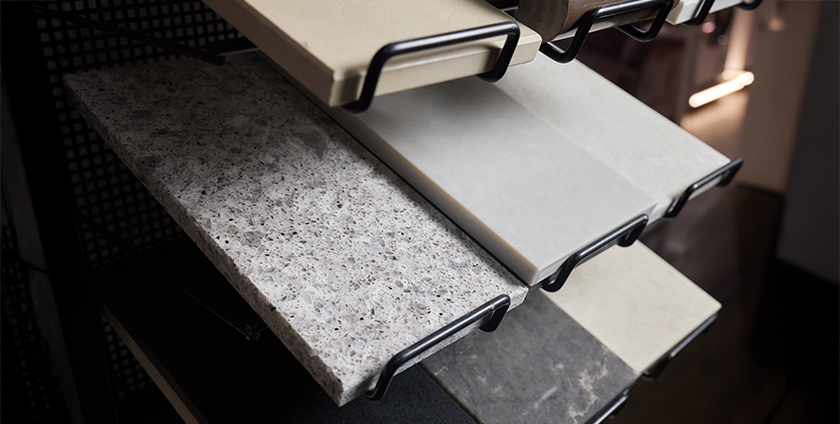
When specification decisions are anchored in predictability and execution clarity, sintered stone in architecture moves from a surface choice to a project strategy. This is where Arvicon fits into the process. As a manufacturer, supplier, and exporter, Arvicon supports commercial projects with defined slab sizes, controlled finish options, and sampling before volume commitments, allowing teams to validate intent early and avoid downstream corrections.
Browse our Sintered Stone catalog to explore available designs, slab formats, and customizable options suited for modern commercial spaces.
FAQs
1. What are the key benefits of sintered stone in commercial projects?
The main benefits of sintered stone include large-format slab availability, non-porous and easy-to-clean surfaces, resistance to scratches, heat, and UV exposure, and stable performance in high-use commercial areas.
2. Why is sintered stone for commercial buildings preferred over smaller surface formats?
Sintered stone for commercial buildings supports large continuous surfaces with fewer joints, helping reduce visual breaks, simplify installation, and maintain consistency across public and high-traffic zones.
3. Where is sintered stone commonly applied?
Sintered stone in architecture is used across countertops, tables, staircases, door and window frames, and architectural cladding, allowing one surface family to span multiple commercial applications.
4. How does commercial interior design with sintered stone benefit from finish options?
Commercial interior design with sintered stone benefits from glossy and matt finishes within the same slab formats, allowing lighting control and visual consistency without changing the base material.
5. How does sustainable sintered stone for buildings support long-term use?
Sustainable sintered stone for buildings supports longer service life through durability and reduced replacement cycles, and the material is described as fully recyclable, aligning with commercial sustainability goals.