- By: SEO SEO
- Category: Uncategorized
- 0 comment
Slate is one of the most enduring natural stones used in the built environment. Its combination of geological history, unique physical properties, and versatile industrial applications makes it a go-to material for construction, architectural design, and decorative uses worldwide.
Key Properties of Slate
Slate’s geological formation gives it several properties that make it valuable as a building material:These contribute to slate’s reputation as both an elegant and technically robust material in construction and design.:
| Property | Description |
| Composition | Varying proportions of muscovite, chlorite, mica, quartz, and accessory minerals, causing natural variation. |
| Hardness | Moderately hard; softer than granite but sufficiently durable for flooring and wall applications. |
| Absorption | Low to moderate absorption of water, oils, and liquids. |
| Weathering Characteristics | Weathering varies by mineral composition and density; lower-grade or poorly metamorphosed slate may deteriorate faster in wet conditions. |
| Tendencies | May absorb oils and liquids; softer grades are more prone to surface scratching. |
| Colors | Available in a wide spectrum of colors, depending on mineral composition. |
| Finish | Offered in finishes such as natural cleft, honed, coated, waxed, and treated surfaces. |
Industrial & Commercial Uses of Slate
Slate’s unique properties have led to a wide range of applications:
Roofing
Slate has long been used as a premium roofing material, as it splits into thin slabs that shed water efficiently and last for decades with minimal maintenance.
Flooring and Wall Cladding
Slate’s natural cleft surface and strength make it well suited for both indoor and outdoor flooring.
Counters, Tiles, and Architectural Elements
Slate is used for stair treads, countertops, hearths, and patios, as its stability and workability allow precise cutting and custom finishes.
Specialty and Legacy Uses
Slate has been used historically for items such as blackboards, billiard tables, laboratory tops, and stone tools due to its ability to be split into flat, smooth surfaces.
Landscaping and Paving
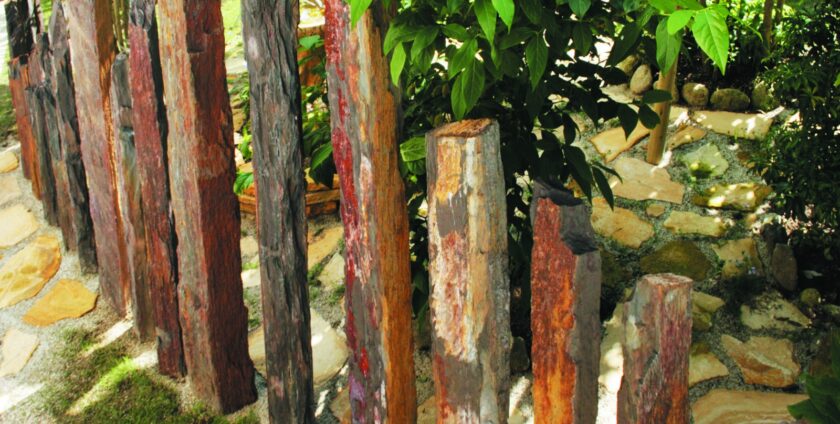
Beyond buildings, slate is used for exterior features such as garden paving, pool surrounds, steps, and terracing due to its durability and textured appearance.
How Slate Is Processed from Quarry to Finished Product
Natural slate is quarried from open mines, then cut and split along natural layers into required thicknesses and finished in different surface textures based on various slate stone uses.
Unlike engineered stones, slate requires minimal chemical treatment, making it a natural material that is widely regarded as an environmentally responsible choice in construction.
Selecting the Right Slate Supplier
When choosing a slate stone supplier, evaluate:
- Material consistency: Uniform color, size, texture, and thickness.
- Quality and grading: Certification for industry standards ensures durability and performance.
- Finish options: Availability of options in surface treatments (e.g., natural cleft, honed, polished).
- Logistics and capacity: Large projects require dependable supply and delivery timelines.
Because slate is heavy and precise, working with a slate stone supplier who provides clear technical documentation and consistent supply is critical.
Slate Products and Solutions from Arvicon
Arvicon offers a wide range of natural slate products designed for modern construction and architectural applications. Our product range offers:
- Variety of finishes: Natural cleft, honed, and polished slate surfaces.
- Extensive colors and grains: Diverse tones such as black, green, red, rust, and grey for aesthetic flexibility.
- Multiple applications: Products that serve exterior façades, interior floors and walls, and architectural detailing.
Arvicon’s stone slate offerings are refined with advanced cutting and finishing techniques, ensuring dimensional accuracy and surface consistency.
Choosing a trusted slate supplier is essential for modern construction. Arvicon, one of India’s leading slate stone manufacturers and direct exporter-suppliers, delivers consistently graded slate in desired sizes and uniform thickness, set apart by precise finishes, durability, and natural beauty for long-lasting, low maintenance architectural solutions.
Discover the full range of Arvicon’s slate stone solutions now.
FAQs
1. Which type of rock is slate?
Slate is a fine-grained, foliated metamorphic rock formed from shale or mudstone, composed mainly of quartz, muscovite, chlorite, and accessory minerals, occurring in colors such as gray, green, purple, or black depending on mineral content.
2. Where is slate commonly used in construction and architecture?
Slate stone uses include roofing, flooring, and cladding due to its durability, low water absorption, and natural appearance.
3. How durable is slate stone compared to other natural stones?
Slate is highly durable, resisting wear, moisture, and weathering over time.
4. What factors should be considered when choosing a slate stone producer?
When evaluating slate stone manufacturers, look for material consistency – including size and thickness – impeccable finishes, quality control, and reliable supply capacity.
5. How does slate perform in different climatic conditions?
Slate performs well across varied climates due to its low porosity, thermal stability, and weather resistance. However, slates with a higher clay content may weather faster in persistently wet conditions.